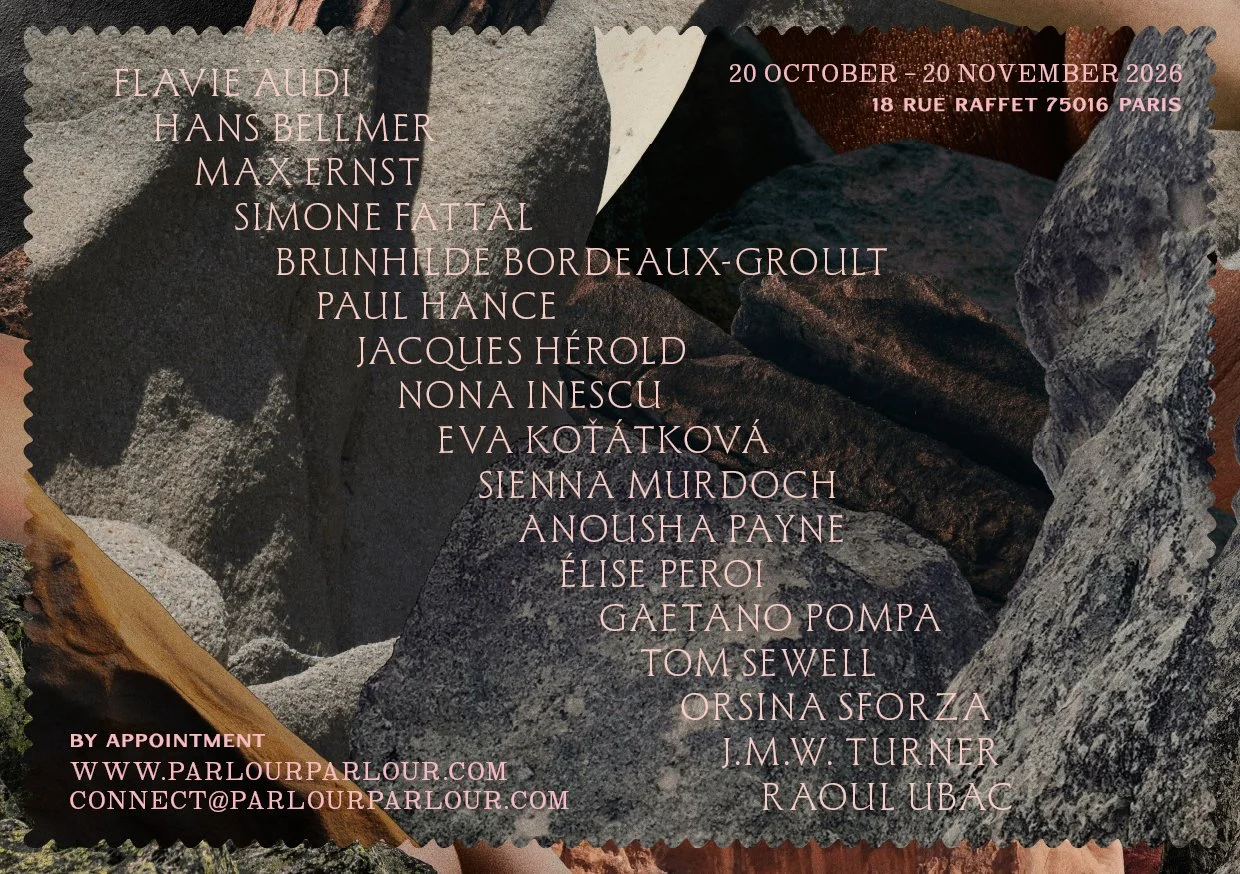
My friend, the artist Brunhilde Bordeaux-Groult, invited me back to organise an exhibition in her remarkable home in Paris. The duplex retains many of its original 1927 Art Deco details, designed by the architect Charles Sarazin, who built the hôtel particulier as his own residence. When Brunhilde later renovated the apartment with her friend, interior designer Alix Thomsen, they kept many of these features intact.

I conceived Flesh & Stone in response to these rooms and the materials already present within them. The title came from Richard Sennett’s 1994 book Flesh and Stone, which had been sitting opposite my desk for months.  Sennett traces the changing relationship between the body and the built environment, from the sensuous life of ancient Athens to the anaesthetised experience of the contemporary metropolis. The rooms at rue Raffet, with the onyx and hammered metal of the bathroom among their surfaces, sit closer to his Athens than to his metropolis.

I kept thinking of my visit in 2022 to see Giuseppe Sanmartino’s Cristo Velato (1753) in the Cappella Sansevero, Naples. The dead Christ lies beneath a translucent veil, yet body and cloth are carved from a single block of marble.

For a moment the eye reads fabric resting on skin before recognising that both are stone. A material associated with permanence is made to carry mortality and sensation.

Flesh & Stone considers the confidence with which we identify and classify matter, and the relationship between the body, the objects around it and the spaces we inhabit.

33 historical and contemporary works are installed throughout the duplex, bringing together painting, sculpture, sound, photography and lighting.  Across the exhibition, materials repeatedly behave against expectation. Bodies fragment or become architectural. Surfaces retain traces of touch and pressure.